

When people come to me, they rarely begin by saying they need breathwork.
They tell me they feel stuck.
Overwhelmed.
Disconnected from themselves.
They’re overthinking decisions, questioning what they want or carrying so much mental and emotional noise that they can no longer hear their own inner voice.
They know something needs to change. They just can’t see what it is.
And that is where breathwork can be so powerful.
Because clarity isn’t always something you can think your way into.
In fact, thinking harder is often the very thing keeping you stuck. When your mind is racing, your body is holding tension and your nervous system is under pressure, it becomes much harder to separate your own truth from the fear, expectations and demands surrounding you.
Sometimes, the quickest route to clarity isn’t through your mind at all.
It’s through your breath.
Why You Can’t Always Think Your Way to Clarity
When something feels uncertain, most of us automatically turn to our minds for an answer.
We analyse the situation from every angle. We make lists. We ask other people what they think. We replay conversations, imagine different outcomes and try to predict every possible consequence.
But the more pressure we place on ourselves to find the answer, the further away it can seem.
That’s because clarity needs space.
When your system feels overwhelmed, your attention naturally narrows towards problems, risks and immediate demands. You can become reactive rather than reflective, making decisions from urgency, fear or a need to make the discomfort disappear.
It doesn’t necessarily mean that you don’t know what you want.
You may simply be carrying too much noise to hear it.
Breathwork interrupts that cycle. It brings your attention away from the constant stream of thoughts and back into your body, where you can begin to notice what you are feeling, what you are holding and what has been trying to get your attention.
It doesn’t hand you an answer.
It creates the conditions in which your own answer can emerge.
Why We Forget to Breathe Fully
We all know how to breathe. It happens automatically from the moment we arrive in the world.
But there is a difference between breathing enough to survive and breathing with awareness.
Modern life continually pulls us up into our heads. We’re planning, working, scrolling, solving, remembering, anticipating and responding. We rush from one responsibility to the next, often without noticing that we’re holding our breath or breathing in a shallow, restricted way.
Our posture tightens. Our shoulders rise. Our jaw clenches. Our bellies remain braced.
And our breath begins to reflect the pressure we’re under.
The breath is unusual because it is both automatic and something we can consciously influence. This gives us a practical way of communicating with the body rather than relying solely on the mind.
By changing how we breathe, we can begin to change how we experience the moment.
We create a pause between the pressure and our response.
And inside that pause, there is often more choice than we realised.
What Is Breathwork?
Breathwork is an umbrella term for practices that use conscious, intentional breathing to influence how we feel physically, mentally and emotionally.
Some breathwork techniques are slow and gentle, designed to encourage calm, grounding or focus. Others are more active and can create greater energy, physical sensation or emotional awareness.
In my guided sessions, the main practice I use is called conscious connected breathwork.
This involves a continuous, rhythmic three-part breath:
- You inhale into the belly.
- You continue the inhale into the chest.
- You release the breath without pausing before beginning again.
The breath remains connected, creating a circular rhythm that helps move your attention away from the analysing mind and more deeply into your body.
Although the breathing pattern itself is simple, the experience can be profound.
As the session progresses, you may become more aware of emotions, thoughts, memories or physical tension that you hadn’t consciously recognised. You may notice where you have been gripping, controlling, suppressing or simply pushing through.
You are not being asked to force a release or manufacture an emotional experience.
You are creating enough space for your body to show you what it is ready to acknowledge.
Why Breath Creates Clarity: The Science and the Soul of It
There is growing scientific interest in the relationship between breathing practices, stress and emotional wellbeing.
Research indicates that different forms of breathwork may help reduce self-reported stress, anxiety and symptoms of low mood, although researchers also stress that the evidence is still developing and that different breathing techniques should not all be treated as though they produce identical effects.
Slow, controlled breathing has been associated with changes in cardiovascular and autonomic nervous-system activity, including measures connected with heart-rate variability and the interaction between breathing and heart rhythm.
Conscious connected breathwork is more active than slow relaxation breathing. During the connected breathing phase, it may temporarily increase physical activation and alter carbon-dioxide levels, which can contribute to sensations such as tingling, temperature changes, light-headedness or tightness in the hands. These sensations do not mean you are doing it “better”, and they are not something you need to chase.
This is why the session is carefully guided and includes preparation, grounding and time for integration afterwards.
But there is also a less measurable aspect of breathwork.
It is the moment the usual mental commentary softens.
The moment you stop trying to explain, solve or justify everything and begin listening to what your body has been communicating.
You may recognise that the decision you have been wrestling with is already made within you.
You may see how much pressure you have been carrying.
You may feel an emotion you haven’t allowed yourself time to experience.
Or you may simply feel stillness — perhaps for the first time in a very long while.
This is where science and soul meet.
Not in making exaggerated promises about what the breath can “cure”, but in recognising that your body can offer information your busy mind has been drowning out.
Breathwork for Release, Clarity and Connection
Breathwork experiences are deeply individual. No two people — and no two sessions — are exactly the same.
However, the shifts tend to fall into three connected areas.
Release
We carry far more than we consciously realise.
Unexpressed emotion. Other people’s expectations. The pressure to keep coping. Old beliefs about who we should be. Conversations we never had. Decisions we keep postponing.
Sometimes, emotional release happens visibly through tears, sound, movement or laughter.
Sometimes it is quieter.
A softened chest. A deeper exhale. A sense that something has loosened. The realisation that you no longer need to carry a particular story in the same way.
Release doesn’t have to be dramatic to be meaningful.
Clarity
One of the biggest reasons people struggle to find clarity isn’t because they don’t know the answer.
It is because they are too overwhelmed to hear it.
As the noise settles, you may begin to see your situation from a different perspective. A decision can feel simpler. A boundary can become more obvious. The next step may appear without needing the entire journey to be mapped out.
Clarity doesn’t always arrive as a lightning bolt.
Sometimes it is a quiet but certain knowing:
This matters.
This needs to change.
This is my next step.
Connection
Breathwork brings you back into relationship with yourself.
Not the capable version who manages everything.
Not the role you perform for your family, clients, colleagues or community.
You beneath all of that.
It gives you space to notice what you need, what you feel and what is true for you now.
Many people spend so much time responding to everyone and everything around them that they become disconnected from their own internal signals.
Conscious breathing offers a route back.
Not towards a newer or improved version of you, but towards the part of you that has been there all along.
What to Expect in a Breathwork Session
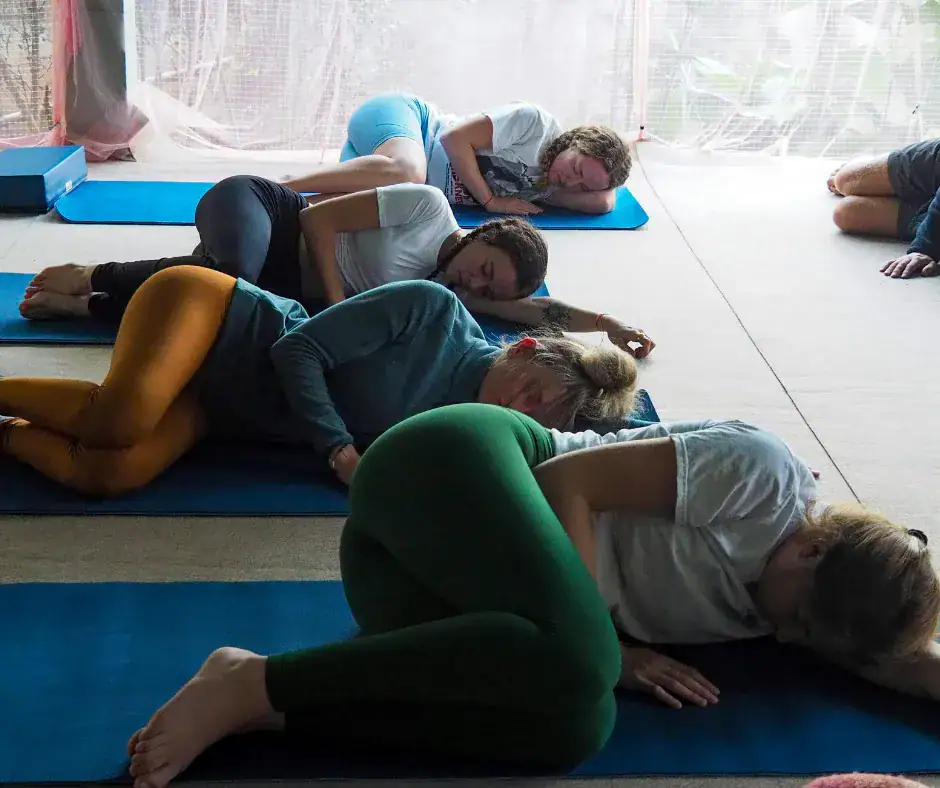
You do not need any previous experience to attend a guided breathwork session.
We begin by creating a safe, grounded environment and explaining the breathing technique, what you may experience and how to adjust your breath whenever you need to.
You remain in control throughout the session.
We usually begin with an intention. This isn’t about demanding a particular result from the breath. It is simply an opportunity to identify what you would like to explore, invite in or release.
Your intention might be:
- To soften the pressure you have been carrying
- To create space around a decision
- To release frustration, grief or anger
- To reconnect with your confidence
- To receive clarity about what needs your attention
- Or simply to allow yourself to pause
I then guide you into the conscious connected breathing pattern.
The active breathing phase is supported by music and near-continuous verbal guidance. You won’t be left wondering what you should be doing or whether you are doing it correctly.
You may experience physical sensations, emotion, imagery, memories, insights or a deep feeling of peace. You may also have a much quieter experience.
There is no correct response.
The intention is not to push yourself towards a breakthrough. It is to stay present with the experience, listen to your body and allow the breath to meet you where you are.
After the active breathing, we move into a period of rest and integration. This is where the breath returns to normal, the body settles and you have space to absorb whatever has arisen.
Often, this quieter part of the session is where clarity lands.
What Transformation Through Breathwork Can Look Like
Transformation does not always arrive as an enormous emotional release or a life-changing vision.
Sometimes it looks like sleeping more deeply that evening.
Feeling less reactive in a difficult conversation.
Finally acknowledging that something isn’t working.
Giving yourself permission to rest without guilt.
Realising that the answer you have been searching for is simpler than you thought.
Recognising that you have been making a decision based on fear rather than truth.
Or feeling more like yourself again.
Breathwork can be powerful because it does not require you to have the perfect words for what is happening.
You don’t need to arrive knowing exactly what is wrong or what you need.
You can begin with the breath and allow the understanding to unfold from there.
A Simple Breath to Create Space Right Now
Conscious connected breathwork is best learned and experienced with an appropriately trained facilitator, but you can use a gentle breathing practice whenever you need to create a little space in your day.
Place both feet on the floor and allow your shoulders to soften.
Breathe in gently through your nose.
Then let your exhale become slightly slower and longer than your inhale.
Do not strain or force the breath. Simply allow the out-breath to communicate to your body that, in this moment, you can soften.
Repeat for five comfortable breaths.
Then ask yourself:
What becomes clearer when I stop rushing for the answer?
You do not have to force a response.
Notice what arrives.
Ready to Breathe Into Greater Clarity?
If you’ve been overthinking, feeling stuck or carrying more than you realised, perhaps the answer isn’t another strategy.
Perhaps you need enough space to finally hear yourself again.
My guided breathwork sessions are designed to help you step away from the mental noise, reconnect with your body and uncover the clarity that already exists within you.
You don’t need to arrive with the answers.
You don’t need to know exactly what you need to release.
And you don’t need to be “good” at breathwork.
You simply need to begin with one conscious breath.
Explore my upcoming breathwork sessions
Because clarity isn’t something I give you.
It’s something I help you uncover.
IMPORTANT SAFETY NOTE
Conscious connected breathwork is an active practice and may not be appropriate for everyone. Participants should complete the relevant health screening before attending and seek medical advice where they have an existing health condition, are pregnant, have recently undergone surgery or are uncertain whether active breathwork is suitable for them.
Breathwork is a complementary wellbeing practice and is not a replacement for appropriate medical, psychological or therapeutic care.