
Reiki: Less Woo-Woo Than You Think
If I had a pound for every time someone said to me, “I’m curious about Reiki, but I’m not really sure I believe in all that stuff…”
And actually, I get it.
If you’ve never experienced Reiki before, the idea that somebody can sit with you, or even be miles away from you, and offer an energy-healing session can sound a little… out there.
You might be wondering what actually is Reiki? Am I supposed to feel something? How on earth can online Reiki work if you’re not even in the same room? And do I have to be spiritual, believe in energy or own an impressive collection of crystals for it to work?
No. You really don’t.
So, let’s take some of the mystery out of Reiki, bust a few myths and talk about what actually happens in one of my Reiki sessions. Because Reiki doesn’t have to be something you completely understand before you’re allowed to experience it.
Sometimes, you can simply allow yourself to stop. And for many of the busy people I work with, that in itself is something they don’t do nearly enough.
What is Reiki healing?
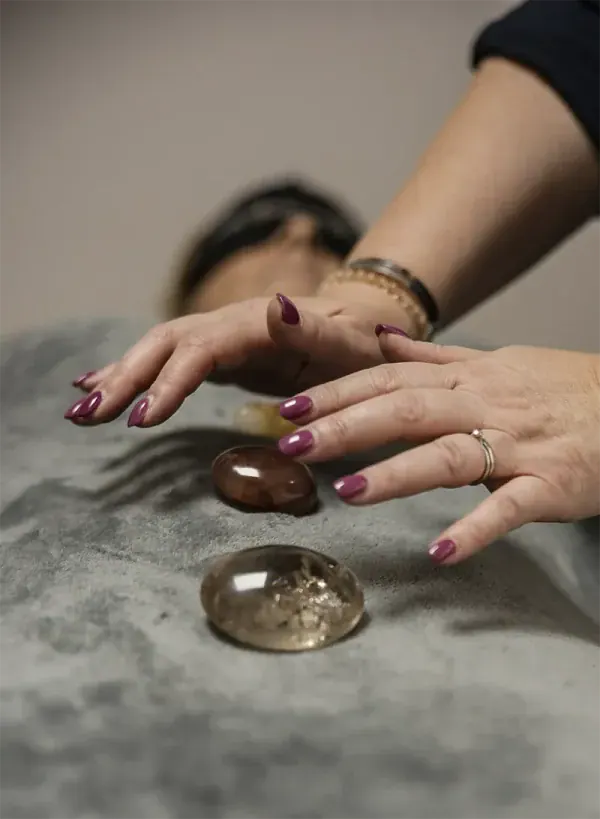
At its simplest, Reiki is a Japanese energy-healing practice. A practitioner traditionally places their hands lightly on, or just above, the body with the intention of supporting relaxation, balance and wellbeing.
I tend to describe it slightly differently. For me, Reiki is an opportunity to stop doing and simply receive.
There is nothing for you to achieve. Nothing to get right. You don’t need to concentrate hard enough, meditate properly or make anything happen. You lie down, get comfortable and allow yourself to be supported.
And if your normal life involves making decisions, looking after everybody else, running a business, managing a family, holding everything together and constantly thinking about what needs doing next, that can feel surprisingly powerful.
Reiki is a complementary wellbeing practice rather than a medical treatment, and research into its effectiveness for specific health conditions remains limited and inconclusive. It should never replace appropriate medical care.
But Reiki doesn’t have to promise to “fix” you to have a place in your wellbeing toolkit. Sometimes what we’re looking for is simply somewhere to soften.
What does Reiki feel like?
This is probably one of the questions I’m asked most. And the slightly annoying answer is “it depends.”
Some people feel warmth or coolness. Some notice tingling, heaviness or lightness. Some see colours or images. Some feel emotional. Some fall asleep. Some feel as though they’ve been lying there for five minutes when almost an hour has passed. And some people don’t notice anything particularly dramatic at all.
None of those experiences means Reiki has been done “properly” or improperly. You don’t need fireworks. In fact, I think we can become far too focused on having a big experience when sometimes the thing our body needs most is something much quieter.
What might I notice after a Reiki session?
Again, everybody is different. People who attend my sessions often describe feeling deeply relaxed, calmer, lighter, clearer or simply more like themselves afterwards.
For some, the difference is immediate and for others, it’s subtle. They may sleep particularly well that night. They may realise their mind isn’t racing quite as much. They may notice that something they were gripping tightly suddenly doesn’t feel quite so urgent.
And occasionally the biggest realisation is simply “I didn’t realise how much I needed that.”
That, for me, is important. We have become incredibly good at normalising tension and we don’t necessarily realise how much we’re carrying until we’re given permission to put some of it down.
Why do people come to Reiki?
People come for all sorts of reasons. Some want relaxation. Some feel emotionally overloaded. Some are going through a period of change. Some have been giving far too much of themselves to everyone else. Some want quiet. Some are curious. And some can’t even articulate exactly what they need. They just know they need something.
Many of the people I work with spend a lot of their lives in doing mode. Achieving, thinking, planning, solving, supporting, holding.
Reiki asks almost the opposite of you. Just allow yourself to receive. No performance, no productivity, no pressure. And sometimes that is precisely the point.
But how can online or distance Reiki possibly work?
Ah, the big one. This is often where even somebody who happily enjoys an in-person Reiki session raises an eyebrow. “Okay Sandra, but you’re telling me you can do this while I’m sitting at home?” Yes.
Within Reiki practice, distance Reiki is based on the principle that the energetic connection used in Reiki isn’t dependent upon physical touch or being in the same geographical space.
From a scientific perspective, there isn’t currently established evidence demonstrating a Reiki energy field or a mechanism by which Reiki energy travels over distance. Research into Reiki generally remains inconclusive. And I’m completely comfortable saying that. I don’t need you to suspend your critical thinking to come to one of my sessions.
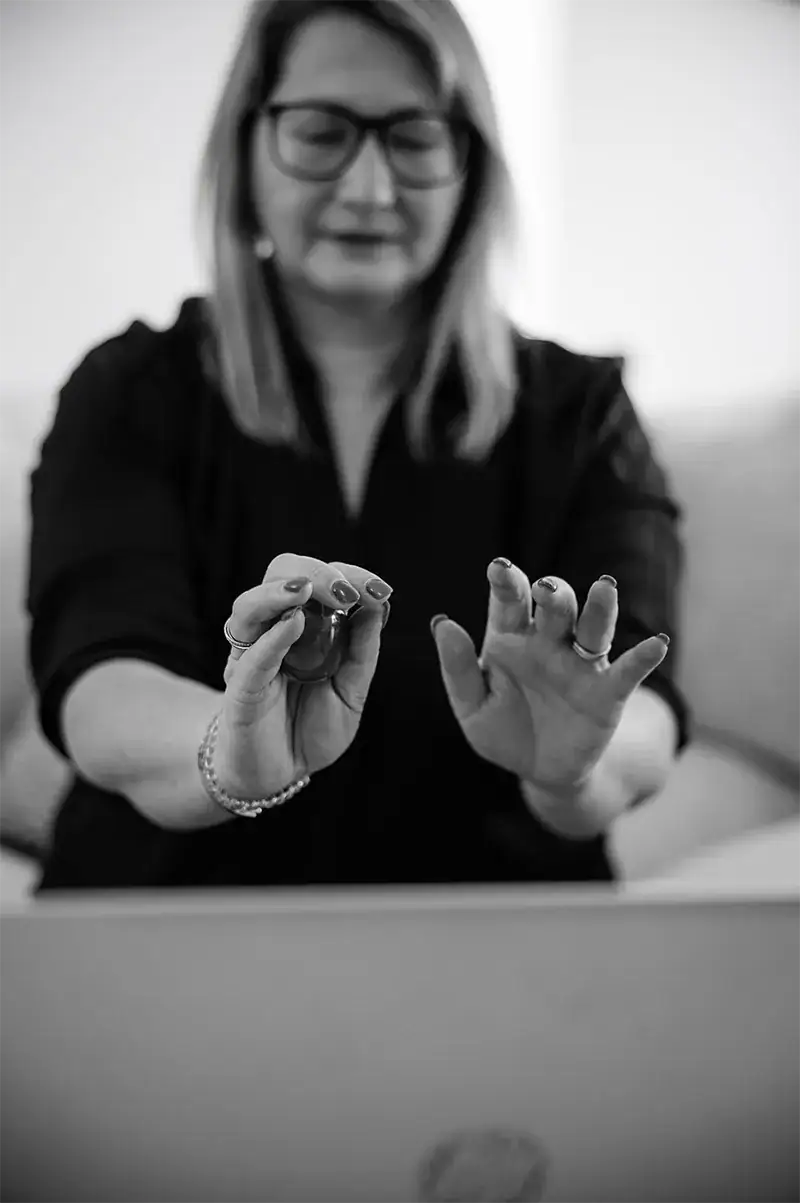
What I can tell you is what the experience looks like. During my online group Reiki sessions, you are in your own home, in a space where you already feel comfortable. You don’t have to drive anywhere afterwards. You don’t have to make conversation. You don’t have to immediately switch back into the outside world.
You simply get comfortable, join me online and allow yourself to receive the session. For many people, being at home actually makes it easier to let go.
What happens during one of my online group Reiki sessions?
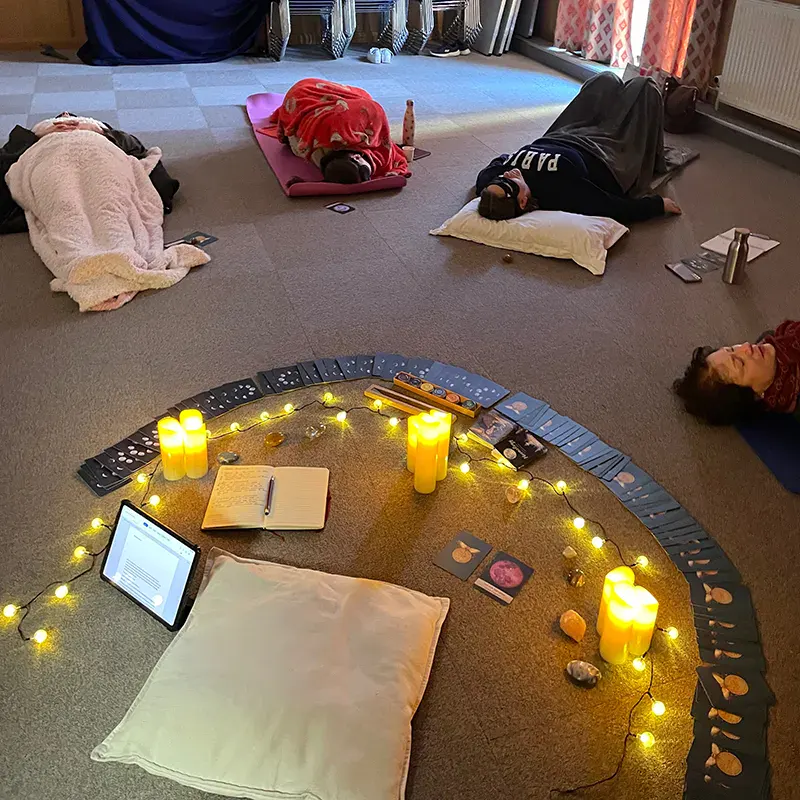
First of all, this isn’t a Zoom meeting where you’re expected to sit upright staring at a screen for an hour. Quite the opposite. I want you comfortable. You can sit or lie on your bed, your sofa, your yoga mat or wherever you feel safe and relaxed.
We’ll begin by arriving into the space together and allowing the noise of the day to settle. I’ll guide you into relaxation before moving into the Reiki itself. During that time, there’s nothing you need to do. You can close your eyes, listen, rest and receive.
I may weave gentle meditation or intention into the session depending on the theme. And then, importantly, there is space to come back gradually. I don’t want you going from deeply relaxed to “Right, what’s next?” in thirty seconds flat. This is a pause, so let it actually be a pause.
How should I prepare for an online Reiki session?
Keep it simple. Find somewhere you won’t be disturbed, put your phone on Do Not Disturb and make yourself physically comfortable.
You might want a blanket, pillows or cushions, water nearby, headphones if they help you switch off, softer lighting, an eye mask, perhaps a candle or your favourite crystal if that’s something you enjoy. But none of those things is essential. You don’t need to create a miniature healing sanctuary in your spare bedroom.
The most important thing is that you can be comfortable and undisturbed. And if possible, give yourself a little breathing room afterwards rather than scheduling something demanding the second we finish.
The five Reiki principles
Traditional Reiki practice is also associated with five principles or precepts, linked to Mikao Usui and the development of Usui Reiki. You’ll find slightly different translations and wording, but they’re commonly expressed along the lines of:
Just for today, I will not anger.
Just for today, I will not worry.
Just for today, I will be grateful.
Just for today, I will do my work honestly.
Just for today, I will be kind to every living thing.
What I love most about these principles is the phrase: Just for today. Not forever. Not “from now on I must never worry again.” Not another impossible standard to hold yourself to. Just today.
What can I choose today? What can I release today? Where can I choose gratitude or kindness today? And perhaps, where can I offer some of that kindness to myself?
Reiki myths I’d really like to bust
Myth 1: You have to be spiritual for Reiki to work
No. You don’t need a particular belief system, and Reiki isn’t a religion. You can be deeply spiritual, completely pragmatic or somewhere in between. You are welcome.
Myth 2: You have to “believe” in Reiki
I don’t need you to convince yourself of anything. In fact, I’d much rather you came curious than tried to force yourself to believe something because you thought you were supposed to. Experience the session. Notice what you notice. Then make up your own mind.
Myth 3: If I don’t feel tingles, heat or see colours, it hasn’t worked
Absolutely not. Some people have very physical or visual experiences during Reiki. Others simply feel relaxed. There isn’t a prize for having the most dramatic experience.
Myth 4: Online Reiki can’t possibly work
Distance Reiki is an established practice within Reiki traditions, although the proposed energetic mechanism has not been scientifically established. So if your logical brain is saying, “But HOW?”, you’re allowed to keep the question. You don’t need to pretend certainty. You can simply experience the session and decide what value it has for you.
Myth 5: Reiki will cure my health condition
This is an important one. I don’t use Reiki to diagnose, treat or cure medical conditions, and it should not be used instead of medical treatment or professional healthcare. Reiki is a complementary wellbeing practice. That distinction matters.
Who are my online group Reiki sessions for?
They’re for the person who feels as though they’ve been “on” for far too long. The person whose head is full of tabs. The business owner who finishes work but never really switches off. The person everybody else relies on. The overthinker. The giver. The one who knows they need to rest but somehow manages to turn even rest into something they need to be good at.
And yes, they’re also for the person who thinks “I’m not sure Reiki is really my thing… but I’m curious.” You don’t have to arrive as a Reiki convert. Curious is enough.
I’m sceptical. Is Reiki really for me?
Possibly. And I’d rather say possibly than tell you everybody “needs” Reiki. Healthy scepticism doesn’t bother me. You don’t need to hand over your common sense at the door.
The scientific evidence around Reiki is still limited. Research hasn’t established the energy field proposed in Reiki theory, and studies looking at Reiki for specific health outcomes have produced inconsistent results.
But there is a difference between saying “the science hasn’t established this mechanism or clinical effect” and saying “therefore you’re not allowed to find the experience valuable.” You can hold both. You can be curious and discerning. You can enjoy something without needing to explain every aspect of it. You can notice how you feel before, during and after.
That is the invitation I would give you. Don’t come because somebody told you Reiki will change your life. Come because you’re curious about what might happen when, for once, you stop doing, stop holding and give yourself permission to receive.
Perhaps you don’t need another thing to DO
This is where I think Reiki fits so beautifully into modern life. There is no shortage of advice telling us what else we should be doing for our wellbeing.
Journal every morning. Meditate. Exercise. Get your steps in. Drink the water. Take the supplements. Do the morning routine. Do the evening routine. Optimise your sleep. Optimise your productivity.
Sometimes even “self-care” becomes another bloody job. Reiki isn’t asking you to achieve anything. For that little pocket of time, you don’t have to improve yourself. You can simply receive.
And maybe that’s the myth I most want to bust. Rest doesn’t have to be earned. Stillness isn’t unproductive. And receiving isn’t doing nothing. Sometimes, it is exactly what you needed.